
Winston-Salem, N.C. (Feb. 10, 2026) — Pine State Development today announced findings from independent analysis that show development patterns at Welden Village generate significantly higher property tax value per acre compared to conventional developments in the Kernersville area, with implications for long-term municipal fiscal health.
The comprehensive Selected Site Analysis, conducted by Urban3, a nationally recognized consulting firm specializing in land value economics, examined various residential and commercial properties throughout Kernersville and Welden Village. The study found that Welden Village developments consistently outperform traditional suburban patterns by approximately 200%, generating twice the tax value per acre.
Key findings from the analysis include:
- Townhomes at Welden Village generate an average of $4.4 million per acre compared to $1.1 million per acre for comparable townhomes in the Falls Grove neighborhood.
- Welden Village commercial development achieves $5.1 million per acre, significantly exceeding Main Street Kernersville’s $3.6 million average and far surpassing big box retail at $0.7 million per acre.
- Missing middle housing (duplexes, townhomes, and small multifamily) generates $1.0 million per acre on average, more than double the $0.4 million per acre produced by standard single-family developments.
“A Welden townhouse is 4 times more tax productive than a neighboring townhome community, and 11 times more potent than the average single-family detached home,” said Joseph Minicozzi, principal at Urban3. “When communities prioritize land efficiency alongside quality design, they’re not just building neighborhoods, they’re building long-term fiscal stability.”
“This analysis validates what we’ve long understood about smart growth and efficient land use,” said Justin Mendenhall, Director of Sales & Operations with Pine State Development. “Welden Village demonstrates that thoughtfully designed, compact development patterns don’t just create vibrant, walkable neighborhoods. They generate substantially more tax revenue per acre for the community. This means better infrastructure, improved services, and a stronger fiscal foundation for Kernersville’s future, all while preserving more open space and natural areas.”
The Urban3 study used value per acre (VPA) as the primary metric, which normalizes total property values to the land area consumed. This approach provides an “apples-to-apples” comparison of financial productivity across different development types, much like miles per gallon measures vehicle efficiency regardless of tank size.
The analysis revealed that even within similar property types, design choices significantly impact productivity. For example, comparing a neighboring Kernersville townhouse community and Welden Village townhouses, these two developments have comparable total market values of approximately $25 million and $24 million, respectively, but Welden Village achieves this on 9.5 acres compared to 21.2 acres, making Welden Village more than twice as productive per acre.
The study also highlighted the enduring value of historic Main Street properties and mixed-use developments. Historic commercial buildings along Kernersville’s Main Street show some of the highest values per acre in the city, ranging from $1.4 million to $8.5 million per acre. At the same time, The Factory, a converted 1884 tobacco facility now serving as a mixed-use space, generates $3.1 million per acre and produces equivalent total value to a Walmart on half the land.
For municipalities facing infrastructure costs, service demands, and fiscal constraints, the implications are significant. Development patterns that maximize value per acre can help communities build long-term financial resilience, create more diverse, affordable housing options, and preserve community character.
The complete analysis includes detailed assessments of residential properties ranging from large-lot single-family homes to apartments, commercial developments from big box stores to Main Street businesses, and mixed-use properties throughout Forsyth County.
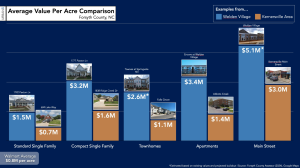
Infographic courtesy of Urban3, source: Forsyth County Assessor (2024) Google Maps
About Pine State Development
Pine State Development is a premier home builder in the Triad, dedicated to crafting communities that combine modern amenities with timeless design. With a commitment to quality, innovation, and customer satisfaction, Pine State Development continues to shape the future of residential living in North Carolina. For more information, visit Pine State Development online. The company is a proud member of the Carolina Core initiative, a strategic economic region in central North Carolina spanning from Winston-Salem to Fayetteville offering certified megasites, industrial and mixed-use development land, and a skilled workforce to attract advanced manufacturers and business investment.